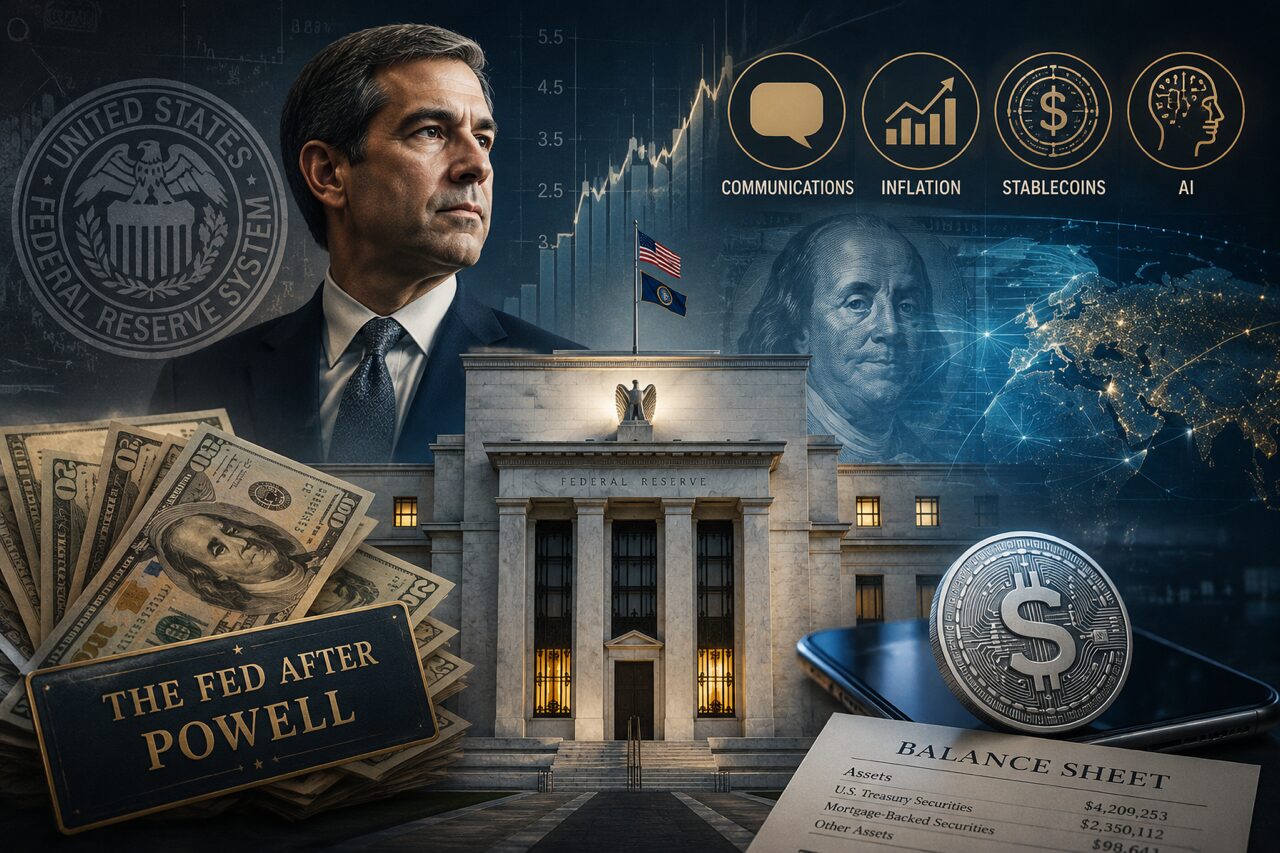

For nearly two decades, investors have lived in an era in which the Federal Reserve has become the world’s most closely watched economic institution. Markets dissect every speech, every projection, every press conference, and often every adjective uttered by the Chair. Kevin Warsh appears to believe that this model has gone too far.
This is bigger than interest rates.
Most commentary surrounding a new Federal Reserve Chair focuses on whether rates will rise or fall. That framing misses the larger story.
Interest-rate decisions change every six weeks. Institutional philosophy can shape central banking for a generation.
The more important question is not whether Warsh is hawkish or dovish. It is whether he is attempting to redefine what the Federal Reserve should be.
The answer increasingly appears to be yes.
If the early months of his chairmanship are any guide, Warsh is attempting something far more ambitious than changing interest rates. He is trying to redefine the relationship between the Federal Reserve, financial markets, and the broader economy.
Kevin Warsh is not simply a new Federal Reserve Chair with a different communication style. He appears to represent a materially different theory of central banking.
The early signs suggest that the Warsh Fed will be less communicative, more skeptical of forward guidance, more focused on price stability, more interested in balance-sheet normalization, more aligned with Treasury on the architecture of money and banking, and more willing to revisit the institutional machinery built over the Bernanke, Yellen, and Powell eras.
That does not necessarily mean a reckless Fed, a politicized Fed, or a Fed preparing to abandon its core responsibilities. The better interpretation is more subtle. Warsh appears to believe the Federal Reserve became too transparent, too market-sensitive, too willing to use its balance sheet as a standing liquidity backstop, and too comfortable with the idea that financial markets should always be guided, reassured, and stabilized by the central bank.
That is a major shift. If Powell’s Fed was defined by crisis management, maximal transparency, and an expansive balance sheet, the Warsh Fed may be defined by institutional retrenchment: less talk, less accommodation of markets, more emphasis on inflation credibility, and a narrower conception of what the central bank is supposed to do.
Warsh’s first major moves support that interpretation. At his June 2026 press conference, he announced task forces on communications, balance-sheet policy, data, productivity and jobs, and inflation frameworks. The balance-sheet task force will review the ample-reserves regime and the composition of the Fed’s portfolio, while the communications review is expected to examine practices such as the Summary of Economic Projections and related public signaling.
Today’s release of the June FOMC minutes, the first under Chairman Warsh, largely reinforces this shift. Although the Committee held rates steady, the minutes reveal a meaningful internal debate over persistent inflation and the possibility that additional tightening may ultimately be required. Yet the accompanying policy statement deliberately avoided signaling a future course of action. Rather than using communications to shape market expectations, the Warsh Fed appears increasingly comfortable allowing uncertainty to remain until policymakers have greater confidence in the incoming data. That represents a meaningful departure from the Fed’s reliance on forward guidance over the past decade.
This is not cosmetic. It is a whole-of-institution review.
Experts and former government officials we spoke with generally viewed the communications agenda as the first and most visible part of the Warsh project.
One expert described the objective as reducing the Fed’s influence over financial markets: Warsh wants the Fed to be “less involved in the markets,” with “a lot less detail” and fewer signals for investors to trade around. The same expert predicted that “communication definitely will be the first thing that happens,” because it is the most immediate way for Warsh to distinguish his Fed from Powell’s.
That view is already visible in the public debate. Reuters reported that Warsh removed forward guidance from the post-meeting statement and pared back economic commentary, prompting discussion among analysts about whether the Fed’s meeting minutes could also become less detailed.
The central question is whether Warsh can make the Fed less talkative without making it less intelligible.
The End of the Powell Transparency Era
Powell inherited the Fed built by Bernanke and Yellen: a central bank that believed transparency was itself a policy tool. Under that model, the Fed improved transmission by explaining its reaction function, publishing projections, using press conferences, and guiding expectations. Markets did not just respond to rate moves. They responded to the Fed’s forecast of its own future behavior.
Warsh appears to believe that model went too far.
Forward guidance can be powerful when the Fed wants to shape financial conditions before taking formal action. It can also trap the central bank inside stale commitments. The Powell Fed experienced this tension during and after COVID, when extraordinary accommodation, aggressive guidance, and a large balance sheet became difficult to unwind once inflation accelerated.
Warsh’s instinct seems to be different: preserve optionality, avoid over-explaining, and force markets to rely more on incoming data and less on Fed choreography.
There is a plausible case for that approach. A central bank that explains everything can end up making markets more fragile, not less. Investors begin trading not only on fundamentals but on expected central-bank reassurance. Every payroll report, CPI print, auction result, or banking stress episode becomes a question of how the Fed will soothe the market.
But there is also a serious risk. Markets do not need omniscience from the Fed, but they do need a reasonably clear reaction function. If the Fed withdraws too much information, investors may not become more disciplined. They may simply become more anxious, placing even greater weight on each stray phrase, dissent, leak, or data release.
Less communication does not necessarily mean less Fed-driven trading. It may mean more volatility around fewer signals.
Price Stability First
The Warsh Fed is likely to put greater emphasis on price stability than the Powell Fed did during the 2019 to 2021 period.
That does not mean Warsh will ignore the employment side of the dual mandate. He cannot. But he can interpret the dual mandate through a more traditional central-banking lens: durable employment gains ultimately depend on stable prices, credible money, and contained inflation expectations.
The difference matters. Powell’s post-2019 framework reflected the experience of years of below-target inflation and a concern that the Fed had tightened too early in prior cycles. That framework was designed to let the labor market run hotter and to tolerate temporary inflation overshoots after long periods below target.
Warsh’s institutional memory appears different. His reference point is not primarily the pre-COVID undershoot. It is the inflation shock and the perception that the Fed stayed too easy for too long. This is one of the major reasons President Trump chose to nominate him.
One expert we spoke with described Warsh as returning to “old school central banking,” focused on price stability and the monetary side of the mandate. In that expert’s words, Warsh is trying to bring the Fed back to the idea that “the job of the monetary authority is to control money supply” and preserve stable prices.
That changes the error function. Powell’s Fed worried about premature tightening, labor-market damage, and market stress. Warsh’s Fed is more likely to worry about credibility loss, inflation persistence, and financial-market dependency.
This also means Warsh may disappoint those who expected him to deliver rapid rate cuts simply because the White House wanted lower rates. Warsh appears to be aligned with the administration on many questions of financial architecture, bank regulation, and digital assets. But his monetary-policy instincts are not obviously accommodative. If inflation remains above target, the Warsh Fed may be reluctant to validate market expectations for easier policy.
The early signal is discipline, not accommodation.
The Balance Sheet May Matter More Than Rates
The balance sheet is where the Warsh Fed could eventually matter most.
Interest-rate policy moves meeting by meeting. Communications can change immediately. But the balance sheet is embedded in the structure of the financial system. Since 2008, and especially since 2020, the Fed’s balance sheet has become more than a monetary-policy tool. It has become part of the market’s liquidity architecture.
Warsh has long been skeptical of that evolution. Reuters reported that Warsh said any balance-sheet policy change would be carefully planned and transparently communicated, while reiterating his view that the Fed’s balance sheet, about $6.7 trillion and down from a roughly $9 trillion peak, should be reduced over time.
That is the key distinction. Warsh is not likely to shock markets for the sake of proving a point. But he does appear to believe the Fed’s footprint should shrink and that interest rates, not asset holdings, should be the primary tool of monetary policy.
One expert we spoke with summarized the philosophy sharply: “The Federal Reserve is not there to service financial markets. It’s the central bank, it’s the bank to banks.” In that view, the Fed should provide liquidity to banks when the banking system needs liquidity, but should not treat hedge-fund liquidity, market comfort, or asset-price stability as standing central-bank obligations.
Whether one agrees with that characterization or not, it captures an important intellectual shift. Rather than viewing abundant liquidity as an enduring feature of modern finance, Warsh appears to see it as an emergency tool that became too permanent.
The balance-sheet task force will therefore be one of the most important developments to watch. If the Fed rethinks the ample-reserves regime, changes reinvestment practices, reduces long-duration holdings, or alters the composition of the portfolio, the effects could show up in term premia, repo markets, Treasury auctions, reserve scarcity indicators, and the relative pricing of bills, notes, and bonds.
For investors, this means the Fed story is not only about the funds rate. It is about liquidity, collateral, duration, and the market’s capacity to absorb Treasury supply without a central-bank backstop.
Independence, But Not Isolation
While the Warsh Fed may preserve monetary-policy independence, all signal point towards its aligning more closely with Treasury and the administration on financial regulation, bank supervision, stablecoins, and the broader architecture of money and banking.
One expert we spoke with drew the line clearly. On bank regulatory policy, the expert described Warsh and the administration as “lockstep.” On monetary policy, however, the same expert expected Warsh to operate independently, even if ideologically aligned with the White House.
The Supreme Court’s decision in Trump v. Cook reinforced the special status of the Federal Reserve. The Court blocked President Trump’s attempted removal of Governor Lisa Cook, emphasizing the Fed’s statutory structure and the significance of for-cause removal protection. Reuters described the ruling as giving the Fed a safeguard even as the Court expanded presidential removal authority over other agencies in a separate decision.
The result is an unusual institutional landscape. The Fed may be more protected than many other economic regulators, but it operates inside an administration pursuing a more aggressive financial-regulatory agenda.
That means monetary policy may remain comparatively insulated, while banking, digital assets, supervision, and payments become more politically responsive. For markets, the Fed remains the independent anchor. For regulated firms, the broader financial architecture may move faster and more directionally than it did under Powell.
Banking Regulation and Stablecoins
Stablecoins are the bridge between domestic financial regulation and global monetary strategy.
Supporters argue that dollar-denominated stablecoins can extend dollar dominance by making digital dollars available around the world. Critics argue that stablecoins are essentially private money that can drain bank deposits, weaken sovereign monetary systems, create runnable shadow-money instruments, and transmit stress between banks and crypto markets.
Both views deserve to be taken seriously.
The GENIUS Act created a federal framework for payment stablecoins, and regulators, including the OCC, Federal Reserve, FDIC, NCUA, and Treasury, have roles in implementation. The OCC has already issued proposed rules to implement the Act for payment stablecoin activity. A rulemaking tracker notes that several implementing regulations are due by July 18, 2026, one year after enactment.
The Fed’s role is particularly important because the Fed is not merely a bank regulator. It is the central bank, the operator of key payment-system functions, the institution responsible for monetary-policy implementation, and the ultimate guardian of financial stability.
That broader mission may make the Fed more cautious than other agencies, even under a deregulatory Republican Chair. The OCC can move aggressively within its lane. The Fed must think about deposit migration, reserve demand, payment-system resilience, bank funding, monetary transmission, and crisis liquidity.
Experts we spoke with expressed a range of views on stablecoins, but several were skeptical of the increasingly common narrative that they are simply a benign extension of dollar dominance. One expert put the concern bluntly: “There’s no way to look at the stablecoin issue as anything other than anti-sovereign.” The point was not merely ideological. The expert’s concern was that sufficiently large private stablecoin networks could pull deposits out of the banking system, reduce lending, and compete with sovereign monetary systems.
That may overstate the case, but it illustrates the seriousness with which many policy experts view the issue.
One concern is that stablecoins could become a parallel deposit system without equivalent supervision, insurance, liquidity regulation, or lender-of-last-resort access. If that system grows large enough, runs may not remain confined to digital-asset markets.
The March 2023 USDC de-peg after Silicon Valley Bank failed remains a useful warning. One expert noted that USDC “broke the buck” during the SVB weekend, briefly falling from $1 to roughly 87 cents. Had the government not protected uninsured deposits, the expert argued, Circle could have faced a far more severe crisis.
The lesson is not that all stablecoins are unstable. The lesson is that bank stress can transmit into stablecoin markets, and stablecoin stress can transmit back into broader financial conditions.
The Warsh Fed will have to decide whether stablecoins are primarily a dollar-dominance opportunity, a financial-stability risk, or both.
The answer is probably both.
China, the Fed, and the Global Dollar System
For China, the Warsh Fed matters because the Federal Reserve remains the operating system of global dollar finance.
China’s exposure runs through multiple channels: Treasury yields, reserve management, dollar liquidity, sanctions, payment-system fragmentation, stablecoins, and the strategic competition over AI-enabled productivity.
“It’s amazing. Anything Warsh says right now is being closely studied all over the world,” said one Hong Kong based Fed watcher who serves on an advisory board to China’s central Government. “It’s not just about interest rates. It includes AI and technological advancement.”
Aside from AI and technological competition broadly, which are issues that transcend even the Fed, most direct channel is the Treasury market. China remains deeply exposed to dollar rates and Treasury-market liquidity, even as its reported Treasury holdings have declined. Reported holdings do not tell the whole story because custodial holdings through financial centers such as the United Kingdom, Belgium, and Luxembourg can obscure the final owner. But the strategic point remains: any Fed policy that changes long-term yields, term premia, or Treasury-market functioning matters to China’s reserve portfolio.
A Warsh Fed that pushes balance-sheet normalization could increase the amount of duration private markets must absorb. If that happens while Treasury issuance remains elevated, investors should watch term premia, repo-market stress, reserve scarcity, and auction demand carefully.
A second channel is dollar liquidity. Even if the dollar gradually loses share in some trade settlement or reserve functions, the Fed remains unmatched as the world’s emergency dollar-liquidity provider. As one expert put it, the dollar could lose share in oil contracts or trade-related transactions, but there is still “no other peer” when it comes to the Fed’s role as the global lender of last resort.
That is a powerful distinction. De-dollarization in trade invoicing is not the same as de-dollarization in crisis finance.
For China, the question is not whether the PBOC has dollars. It does. The question is whether a geopolitical or financial shock could create dollar-funding pressure in Chinese banks, Hong Kong markets, offshore borrowers, or Belt-and-Road counterparties. In that kind of crisis, Fed swap lines, Treasury channels, and geopolitical alignment would matter enormously.
A third channel is RMB internationalization. A less transparent, more hawkish, balance-sheet-normalizing Fed could create openings for China if dollar volatility rises. But the structural constraints on the RMB remain substantial: capital controls, limited convertibility, governance concerns, legal uncertainty, and the absence of a deep, open, risk-free RMB asset comparable to Treasuries.
The RMB can gain share in bilateral trade settlement without becoming a true reserve-currency competitor. That distinction should not be lost.
A fourth channel is stablecoins. Dollar stablecoins could function as a private-sector form of dollar internationalization, especially in markets where U.S. banks are absent or constrained. That could complicate China’s digital-yuan strategy and reinforce dollar usage in emerging markets.
But poorly regulated stablecoins could have the opposite effect. If they become associated with runs, sanctions, surveillance, or financial instability, foreign governments may accelerate local-currency settlement, CBDCs, and non-dollar payment systems.
For China, U.S. stablecoin policy is not merely a crypto issue. It is a monetary-order issue.
AI, Productivity, and Strategic Competition
Warsh has also linked AI and productivity to the monetary-policy outlook. The argument is straightforward: if AI raises productivity growth, the economy may be able to grow faster without generating the same inflation pressure. That could affect estimates of potential output, labor-market tightness, the neutral rate, and the appropriate path of monetary policy.
The promise is real, but the timing is uncertain.
Experts we spoke with were generally skeptical of using AI optimism as a near-term justification for easier monetary policy before measurable productivity gains appeared in the data.
One expert described Warsh’s AI thesis as “not really developed enough” to justify the rate-cut expectations that had surrounded parts of the early debate over his chairmanship. Another called it “not well fleshed out,” and cautioned that, for now, “all these decisions are going to be based on fundamentals until otherwise.”
That skepticism seems warranted. AI may eventually prove to be a general-purpose technology with profound macroeconomic consequences. But central banks likely cannot responsibly set near-term rates based on a productivity story that remains largely speculative. Warsh’s productivity and jobs task force is therefore important. It gives the Fed an institutional mechanism to study AI without immediately embedding optimistic assumptions into policy.
For China, and other international competitors, this debate matters beyond monetary policy. If AI materially raises U.S. productivity, it could support stronger U.S. growth, higher real rates, deeper capital-market strength, and a more durable dollar. If the Fed overestimates AI-driven productivity and eases too soon, inflation could reaccelerate, damaging Fed credibility and creating instability that U.S. competitors would exploit.
The key question is whether the Warsh Fed treats AI as data or as narrative.
Data means measurable productivity gains, investment diffusion, labor-market effects, margin changes, and sectoral price impacts.
Narrative means using AI optimism to justify policy preferences before the evidence arrives.
The former could strengthen U.S. macroeconomic performance. The latter could repeat the central-banking error of believing a convenient story for too long.
What to Watch
The Warsh Fed is still early, and institutional change at the Federal Reserve is rarely immediate. The Fed is a committee system with strong staff, legal constraints, market responsibilities, and internal checks. Warsh may speak like a reformer and govern more cautiously than expected.
Still, the direction of travel is becoming clearer.
Five indicators deserve close attention.
First, communications reform. Watch whether the Fed changes the Summary of Economic Projections, the dot plot, meeting minutes, press-conference practices, and post-meeting statements.
Second, balance-sheet policy. Watch the task force process, reinvestment policy, reserve-regime signals, SOMA composition, and repo-market conditions.
Third, inflation credibility. Watch whether the Fed tolerates above-target inflation in the name of growth or labor-market protection, or whether it reasserts price stability as the dominant lens.
Fourth, stablecoin implementation. Watch how the Fed, OCC, FDIC, NCUA, and Treasury implement the GENIUS Act and whether the regime treats stablecoins as bank-like money, payment instruments, capital-market products, or something genuinely new.
Fifth, AI evidence. Watch whether AI productivity becomes visible in macro data, or whether it remains a narrative invoked in speeches and market commentary.
The Fed After Market Dependence
The Warsh Fed is best understood as a counterreaction to the Powell era.
It is not just about rates. It is about the purpose of the central bank.
Warsh appears to be asking whether the Fed became too central to market psychology, too expansive in its liquidity role, too committed to explaining itself, and too willing to let financial markets assume that the central bank would always be there to guide and stabilize them.
That is a serious question.
One expert we spoke with framed the moment even more broadly, as a conflict between the old financial order and the new one. “What is a bank? What does a bank look like? Is it just taking deposits and making loans? Clearly not. What does the central bank do? Is it just the bank to banks? It’s moved well beyond that.” In the expert’s view, the system has moved so far from its original structure that “somebody needs to be the adult in the room and step in and inject some discipline.”
That may be the clearest way to understand the Warsh project.
If Warsh succeeds, the Fed may become less predictable in its public signaling but more disciplined in its internal framework. Markets may have to rely less on Fed reassurance and more on macro fundamentals. The balance sheet may become less of a standing liquidity facility. Stablecoins may be integrated into the dollar system, but under closer scrutiny from a central bank that understands the risks of private money. And the United States may preserve the dollar’s global role not by making the Fed louder, but by making it more credible.
If Warsh fails, the result could be higher volatility, a less understood reaction function, premature balance-sheet tightening, unstable dollar funding conditions, and renewed questions about whether the Fed can modernize without destabilizing the system it oversees.
For China, and for the global financial system, the stakes are substantial. Treasury yields, dollar liquidity, sanctions, stablecoins, reserve diversification, AI productivity, and the future of the dollar all run through the Federal Reserve in one way or another.
The Warsh Fed may be trying to restore discipline to a financial system that has grown dependent on central-bank liquidity and central-bank explanation.
Whether that effort succeeds will shape not only U.S. monetary policy, but the future of the dollar-centered global order.
###